What Are Strategic Trade Controls?
Strategic Trade Controls (STC) are laws and regulations that govern the management of the flow of dual-use goods, services, and technologies across national borders. These laws and regulations primarily focus on controlling the export of such items in order to balance a country’s commercial and security considerations.
The term “dual-use” sits at the centre of this entire framework. Dual-use means that a good or technology has the potential to be used in military applications, or in the development of Nuclear, Chemical, or Biological Weapons of Mass Destruction (WMD), alongside its civilian or industrial applications. The same item that serves a legitimate commercial purpose can, in different hands or a different context, serve a weapons-related purpose. This is the fundamental problem that Strategic Trade Controls are designed to address.
What Are the Objectives of Strategic Trade Controls?
The primary objectives of Strategic Trade Controls are:
First, preventing the proliferation of WMD and their delivery systems. This covers nuclear, chemical, and biological weapons and the systems that carry or deliver them.
Second, preventing the uncontrolled transfer of conventional arms and military items.
Various nations, including major producers and exporters of dual-use goods and technologies, exercise such controls. India is one of them.
Accordingly, India maintains a harmonized list on export control of dual-use and military items, including software and technologies, having potential civilian and industrial applications as well as military and WMD use. Export of items on this list is restricted or permitted under an export authorization or license, unless specifically exempted, except for certain items that are outright prohibited.
India’s Legal Framework
India has a robust law-based system on non-proliferation and strategic trade related matters that has evolved over the last two decades. This system is based on elements across various national laws. It prohibits access of WMD and their delivery systems to non-state actors, in particular for terrorist purposes, and provides for measures and controls on WMD, their delivery systems, and related dual-use goods and technologies.
The relevant legislations are:
The Weapons of Mass Destruction and their Delivery Systems (Prohibition of Unlawful Activities) Act, 2005 (WMD Act) – This is the centrepiece of India’s non-proliferation legal framework. It prohibits access of WMD and their delivery systems to non-state actors, in particular for terrorist purposes, and provides for criminal consequences including imprisonment for violations. The catch-all provision in India’s export control system draws its authority partly from this Act.
The Foreign Trade (Development and Regulation) Act, 1992 (FTDR Act) – This is the statute under which India’s Foreign Trade Policy is issued and enforced. It was amended in 2010 to add Chapter IVA, which specifically deals with controls on the export of specified goods, services, and technology, including SCOMET controls, and to align with certain provisions of the WMD Act. Most of the administrative penalties for SCOMET violations – fiscal penalties, IEC cancellation – flow from this Act.
The United Nations (Security Council) Act, 1947 – India’s domestic instrument for implementing UNSC resolutions, including UNSC sanctions on non-proliferation and UNSC arms embargoes.
The Customs Act, 1962 – Customs enforcement at the border operates under this Act. Unauthorized exports of SCOMET items can attract consequences under the Customs Act.
The Atomic Energy Act, 1962 – Nuclear materials and nuclear-related equipment and technology fall under a parallel licensing regime administered by the Department of Atomic Energy (DAE). SCOMET Category 0 items are governed by this Act. The DAE notified SCOMET Category 0 in 2016 under this Act.
The Arms Act, 1959 – Arms and ammunition specified in Schedule I of the Arms Rules 2016 are also covered in SCOMET Category 6.
The Chemical Weapons Convention Act, 2000 – India’s domestic implementation of the Chemical Weapons Convention (CWC). Certain chemicals listed in CWC Schedules are reflected in SCOMET Category 1. Voluntary disclosure of non-compliance is not available for violations involving CWC Schedule chemicals.
The Environment Protection Act, 1986 – Covers additional dimensions of dual-use goods particularly in the chemicals and materials space.
The Explosives Act, 1884 – Covers the explosives dimension of controlled items.
The key point is that India’s STC system is not a standalone regulatory instrument. It is anchored across multiple statutes, and violations can attract consequences ranging from fiscal penalties to criminal prosecution and imprisonment.
India’s Commitments to International Conventions and Regimes
India’s STC framework is directly shaped by its commitments to international non-proliferation conventions and its membership in multilateral export control regimes.
Conventions India is signatory to:
The Chemical Weapons Convention (CWC) – India is a signatory to the CWC. The Organisation for the Prohibition of Chemical Weapons (OPCW) is the implementing body.
The Biological and Toxin Weapons Convention (BWC) – India is a signatory to the BWC, which prohibits the development, production, and stockpiling of biological weapons.
UNSC Resolution 1540 – This resolution obliges all UN member states to prohibit access of WMD and their delivery systems to non-state actors, in particular for terrorist purposes, and prescribes measures and controls on WMD, their delivery systems, and related materials, equipment, and technology. India implements this through the WMD Act and the UN Security Council Act.
Multilateral Export Control Regimes – India’s Memberships:
The Missile Technology Control Regime (MTCR) – India is a member of the MTCR, which covers missiles, other delivery systems, and related dual-use items. India’s SCOMET list is harmonized with the MTCR control list.
The Wassenaar Arrangement (WA) – India is a member of the Wassenaar Arrangement, which covers munitions and military items and related dual-use goods and technologies. India’s SCOMET list is harmonized with the WA control lists. The WA also maintains a Sensitive List and Very Sensitive List, which are referenced in IMWG evaluation criteria when applications are assessed.
The Australia Group (AG) – India is a member of the Australia Group, which covers dual-use chemicals, biological items, and related equipment and technology. India’s SCOMET list is harmonized with AG control lists. The AG also maintains a Warning List and Awareness Raising Guidelines, which are referenced in IMWG evaluation criteria.
The Nuclear Suppliers Group (NSG) – India’s SCOMET list is harmonized with NSG guidelines on nuclear-related items and dual-use nuclear equipment and technology, reflected in SCOMET Category 4. Category 0 items are licensed by the DAE under the Atomic Energy Act.
In consonance with the relevant control lists, guidelines, and provisions of these international conventions, mechanisms, and regimes, India regulates the exports of dual-use items, nuclear-related items, and military items, including software and technology, under the SCOMET list.
What Is the SCOMET List?
SCOMET stands for Special Chemicals, Organisms, Materials, Equipment and Technologies.
The SCOMET list is India’s National Export Control List of dual-use items, munitions, and nuclear-related items, including software and technology.
The first control list, described as “Special Materials, Equipment and Technology (SMET)”, was notified in Export Import Policy in 1995. The SCOMET list as it exists today was notified in 2001. The FTDR Act was amended in 2010 to add Chapter IVA related to controls on export of specified goods, services, and technology that includes SCOMET controls, and to align with certain provisions of the WMD Act.
The SCOMET list is maintained as Appendix 3 to Schedule 2 of the ITC (HS) Classification of Export and Import Items. It is implemented by the Directorate General of Foreign Trade (DGFT) under the Ministry of Commerce and Industry. The policy governing SCOMET exports is set out in Chapter 10 of the Foreign Trade Policy 2023 and the procedural details are in Chapter 10 of the Handbook of Procedures 2023.
The list was most recently updated on 23 September 2025.
What Does the SCOMET List Cover?
The SCOMET list covers five broad types of items, reflected in its name:
Special Chemicals (SC) – This category includes chemicals that have applications in various industries but also possess properties that can be used for chemical weapons or military purposes. Examples include chemicals used in the production of pharmaceuticals or agriculture, yet with the potential for use in the development of chemical weapons.
Organisms (O) – Biological agents and organisms fall under this category. It encompasses living entities that may have applications in medical, agricultural, or industrial fields but may also pose a threat in the context of biological weapons or bioterrorism.
Materials (M) – Materials that can be utilized in both civilian and military applications are covered under SCOMET. This includes metals, alloys, composites, and special materials that have properties suitable for dual-use purposes.
Equipment (E) – Various types of equipment that could have applications in strategic fields. This encompasses machinery, devices, or systems with potential dual-use capabilities.
Technologies (T) – The technological aspect of SCOMET involves knowledge and information that can be applied in diverse sectors. Technologies with applications in research, development, and manufacturing, but with the potential for military and WMD use, are included.
Technology and Intangible Technology Transfers – A Critical Point
Under India’s SCOMET regulations, the licensing obligation does not apply only to physical goods. It extends equally to technology related to items specified under the SCOMET list. This means that Intangible Technology Transfers (ITT) related to SCOMET items are also controlled and require authorization from the licensing authority.
Technology is defined as information – including information embodied in software – other than information in the public domain, that is capable of being used in the development, production, or use of any goods or software, or in the development of, or the carrying out of, an industrial or commercial activity, or the provision of a service of any kind in relation to an item specified under India’s SCOMET list.
This information may take the form of:
Technical data – blueprints, plans, diagrams, models, formulae, algorithms, tables, engineering designs and specifications, manuals, instructions, and similar material written or recorded on other media or devices.
Technical assistance – instruction, skills, training, working knowledge, and consulting services.
The practical implication is direct – the SCOMET licensing obligation is not discharged simply by controlling the physical shipment of goods. Any transfer of the above forms of information relating to a SCOMET-listed item, to a foreign person or entity, is itself a controlled act requiring authorization.
Who Does SCOMET Apply To?
SCOMET controls apply to a wider set of persons and entities than many assume. The controls apply to:
- The whole of India including its Exclusive Economic Zone
- Citizens of India outside India; companies or bodies corporate, registered or incorporated in India, or having their associates, branches, or subsidiaries outside India
- Any ship, aircraft, or other means of transport registered in India or outside India, wherever it may be
- Foreigners while in India
- Persons in the service of the Government of India, within and beyond India
Additionally, both new and used goods are subject to SCOMET controls – the condition of the goods does not affect their controlled status.
The SCOMET list also specifies that non-controlled goods containing one or more controlled components, when the controlled component or components are the principal element of the goods and can feasibly be removed or used for other purposes, are still subject to Indian export controls. This is the co-mingling or integration rule.
Where items are classifiable under two or more SCOMET headings, the heading that provides the most specific description shall be preferred. The end-use of the item is a relevant criteria in determining classification.
The Catch-All Provision – When Non-Listed Items Also Get Controlled
One concept every reader must understand before going any further is the catch-all provision, set out in Para 10.05 of the Foreign Trade Policy 2023.
The catch-all provision states that the export of items not in the SCOMET list may also be regulated under the provisions of the WMD Act 2005. The trigger conditions are:
- The exporter has been notified in writing by DGFT that the item has a potential risk of use in or diversion to WMD, their missile systems, or military end-use including by terrorists and non-state actors, OR
- The exporter knows or has reason to believe that the item not covered in the SCOMET list has such a potential risk
In either case, the export of such an item may be denied or permitted subject to the grant of a license, as per the procedure provided for SCOMET items in Para 10.05 and 10.06 of the Handbook of Procedures.
This provision places a positive duty on the exporter. It is not sufficient to check the SCOMET list, find your item absent, and consider the compliance obligation discharged. If you have information or reasonable grounds to suspect that the item could be diverted to WMD, missile, or military end-use, you must seek authorization before proceeding.
The SCOMET List Has Nine Categories – With Different Licensing Authorities
The SCOMET list is organized into nine categories. Each category has a designated licensing authority responsible for evaluating and granting export authorizations.
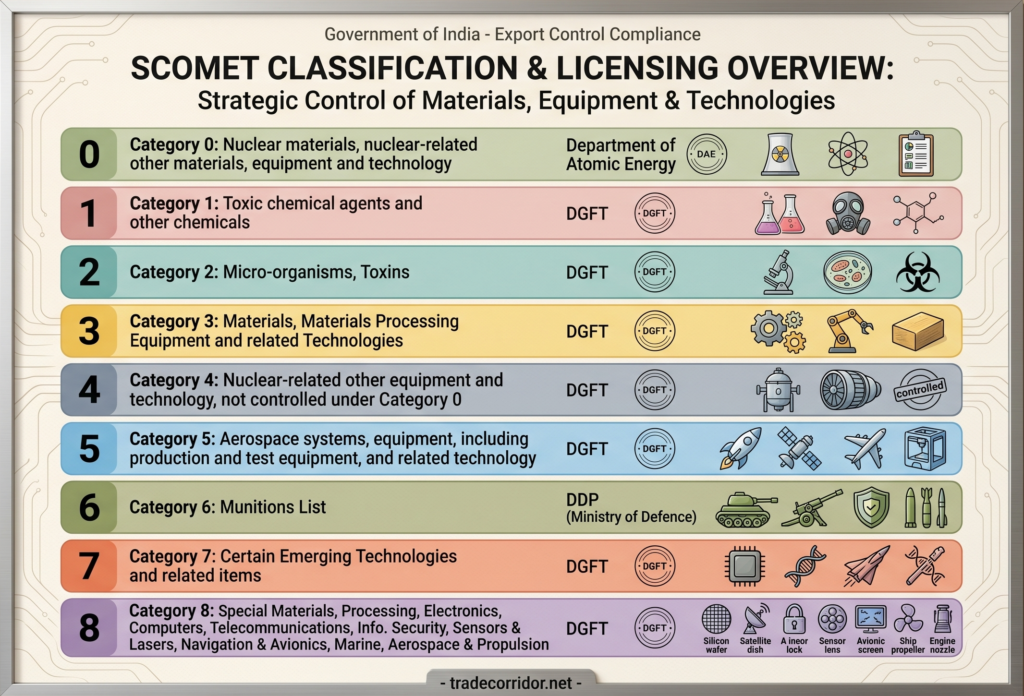
The important point from this table is that most categories are licensed by DGFT, but Category 0 is licensed exclusively by DAE and Category 6 (Munitions) is licensed exclusively by DDP under the Ministry of Defence. Filing an application with the wrong authority is not a procedural technicality – it means your application goes to the wrong place entirely.
Dual-Use in Practice – Examples from the SCOMET List
To make the dual-use concept concrete, the handbook provides the following examples of items on the SCOMET list and their civil versus military potential:
| Category | Product | Civil / Industrial Use | Military / WMD Use |
|---|---|---|---|
| Category 1 | Triethanolamine | Cosmetics, Personal Care Products, Pharmaceuticals | Ammunition Manufacturing, Chemical Weapons |
| Category 1 | Sodium Sulphide | Chemical Manufacturing, Paper and Pulp Industry | Chemical Warfare Agents |
| Category 2 | Clostridium butyricum | Probiotic, Biotechnology | Biological warfare |
| Category 5 | UAVs, Drones | Aerial Photography and Videography, Search and Rescue, Infrastructure Inspection | Surveillance and Reconnaissance, Target Acquisition, Strike Operations, Electronic Warfare, Mine Detection and Clearance |
| Category 6 | Explosives, HMX, Propellants | Demolition and Construction, Mining, Pyrotechnics | Demolition and Breaching, Landmines, Controlled Explosive Devices, Blast Mitigation |
| Category 7 | Quantum and Emerging Technologies | Research, healthcare, secure banking, telecom, navigation, materials science | Secure military communications, cryptanalysis resistance, submarine detection, precision navigation without GPS |
| Category 8 | Telecommunication systems and equipment, Encryption Software, Information Security | Telephony, Television and Broadcasting, Satellite Communications, Energy and Utility Monitoring | Command and Control, Secure Communication, Secure Military Networks, Interoperability |
| Category 8 | Integrated circuits | Consumer Electronics, Smart Home Technology, Industrial Automation | Missiles and Guided Munitions, Communications and Encryption, Military Electronics |
| Category 8 | Lasers, components and optical equipment | Laser Surgery and Medical Devices, Barcode Scanners and Optical Readers, Entertainment and Laser Shows, Astronomy and Space Observation | Laser Targeting and Range finding, Night Vision and Targeting, Laser Weapons, Laser Range Designators |
What Happens If You Export Without Authorization?
Before we move to the licensing process in the sections that follow, it is important to state clearly what is at stake for non-compliance. Infringements of export control regulations carry the following legal consequences:
- Penal action under Section 11(2) of Chapter IV of the FTDR Act including cancellation of the Importer Exporter Code (IEC)
- Action under Section 14(E) and Section 8(c) of the FTDR Act
- Fiscal penalty of up to 5 times the value of the goods in terms of Section 11(2) of the FTDR Act
- Criminal actions under the WMD Act and Section 14(3) of the FTDR Act including imprisonment
DGFT does encourage voluntary self-disclosure of failures to comply with export control provisions, and treats voluntary disclosure as a potential mitigating factor. However, it also takes strict action under the FTDR Act for violations in cases other than voluntary self-disclosure. The SOP for voluntary disclosure is a separate and detailed framework, covered later in this blog.
That is Section 1 – completely clean, no em dashes, nothing assumed, everything sourced directly from the handbook.
Ready for Section 2?
Leave a Reply