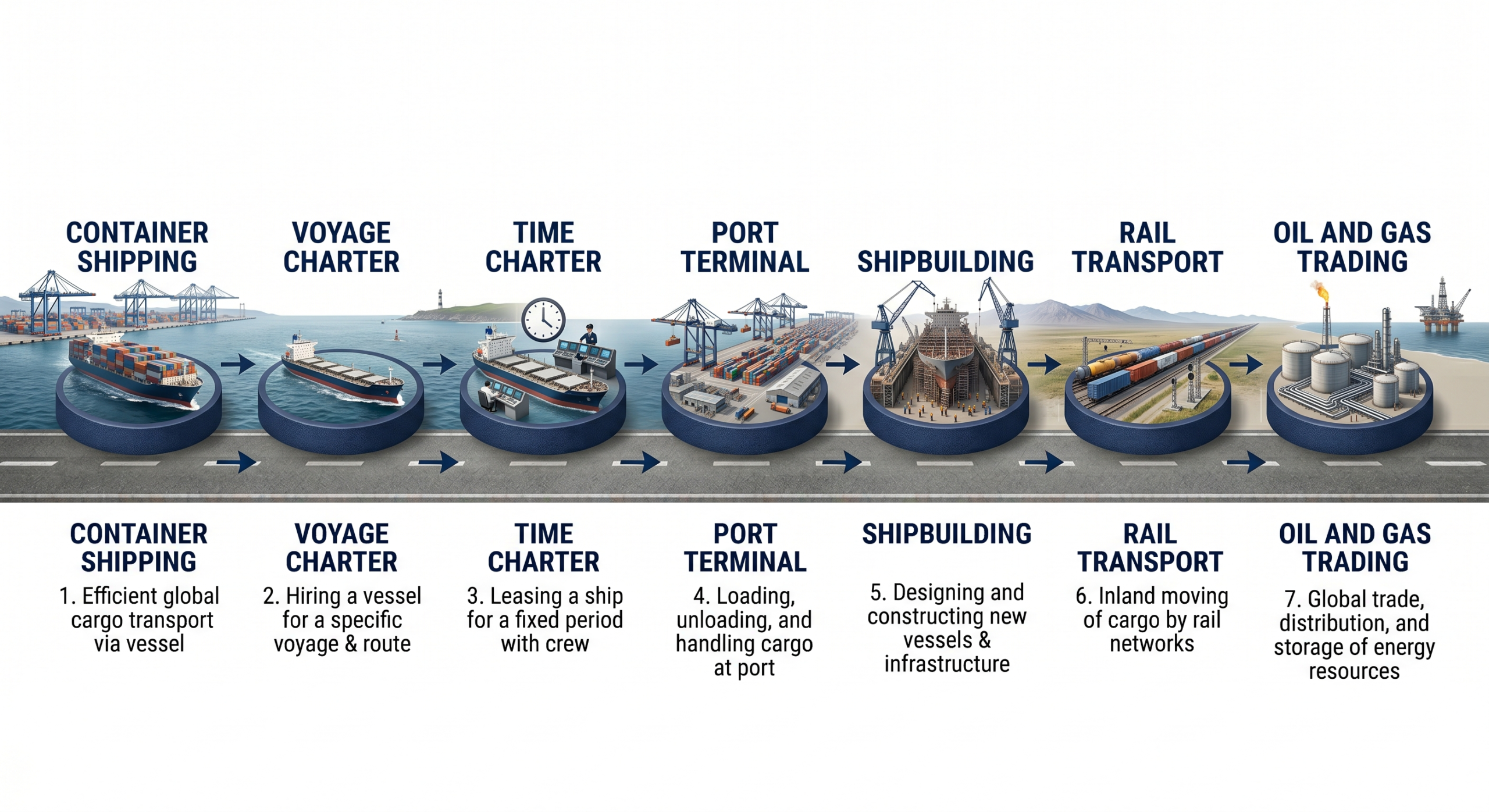
Most people who have been in shipping for years still use the word demurrage incorrectly. They use it for one specific situation in their part of the industry and assume that is the whole picture. It is not. Demurrage exists across multiple areas of shipping and each one operates under a completely different legal framework, a different commercial logic, and a different calculation method. Get them confused and you will misread a contract, miss a dispute window, or pay a bill you did not owe.
This post covers every single context in which demurrage applies in shipping. Start here before reading anything else on this topic.
The One Principle Behind All Demurrage
Before getting into the specific contexts, understand the single commercial principle that connects all of them.
Demurrage exists because time costs money in shipping. A vessel sitting idle costs the shipowner money every hour. A container sitting unreturned costs the carrier money every day. A port terminal with a berth occupied by a vessel that has finished operations but has not sailed costs the terminal money every hour. In every case, one party has agreed to use an asset belonging to another party within a fixed time. When they exceed that time, they pay for it. That payment is demurrage.
The logic is the same everywhere. The legal framework, the calculation method, and the commercial consequences are completely different depending on where you are in the shipping transaction.
1. Demurrage in Container Liner Shipping
This is the most commonly encountered form of demurrage for importers, exporters, and freight forwarders who work in containerised trade.
The shipping line owns the container. When the vessel discharges the container at the destination port, the carrier gives the consignee a fixed number of free days to collect the container, unpack it, and return it empty to the carrier’s nominated depot. That free period is called free time. The moment free time expires, demurrage starts accruing at the rate published in the carrier’s tariff.
The charge is per container per day. It steps up in bands. The longer the container is held, the higher the daily rate. It is billed by the shipping line directly to the consignee or to whoever is named as the notify party responsible for charges.
The key points to understand here are that free time is counted in calendar days not working days in almost every carrier tariff, that the clock starts from discharge not from the day the container becomes available for collection, and that customs delays, document delays, and terminal congestion do not automatically pause the clock unless the carrier specifically agrees to a hold.
At origin, a similar charge applies when the shipper or freight forwarder fails to return the empty container to the port or container freight station after stuffing within the allowed free time. This charge at origin is technically called detention by most carriers though the industry uses demurrage and detention interchangeably and incorrectly. The distinction matters when reading a carrier invoice or disputing a charge.
2. Demurrage in Voyage Chartering
This is the oldest and most legally complex form of demurrage in shipping. It applies in dry bulk, tanker, breakbulk, and project cargo trades where cargo is moved on chartered vessels rather than liner services.
In a voyage charter, the shipowner agrees to carry a specific cargo from one port to another in exchange for a freight rate. The charter party, which is the contract between the shipowner and the charterer, specifies a number of days or hours called laytime that the charterer is allowed to use for loading and discharging the cargo. Laytime is the free time equivalent in this context.
If the charterer takes longer than the agreed laytime to load or discharge, the vessel is detained beyond what was agreed. The shipowner loses the ability to proceed to the next cargo during that time. Demurrage is the compensation the charterer pays the shipowner for that detention. It is expressed as a fixed daily rate agreed at the time of the charter party fixture and it accrues continuously once laytime expires, including through nights, weekends, and holidays unless the charter party specifically provides otherwise.
The principle in English law, which governs the majority of voyage charters globally, is that once on demurrage always on demurrage. This means that once laytime has expired and demurrage has started running, no interruptions pause the demurrage clock except those explicitly agreed in the charter party. Rain, equipment breakdown, labour disputes, and port congestion do not pause demurrage once it has started running unless the charter party contains specific exceptions for those events.
The reverse of demurrage is despatch. If the charterer completes loading or discharging faster than the agreed laytime, the shipowner pays the charterer despatch money at a rate that is typically half the demurrage rate. Despatch is an incentive for efficient cargo operations. It is less commonly encountered than demurrage but it is a real payment that efficient charterers earn regularly.
3. Demurrage in Time Chartering
Time charter demurrage is less commonly discussed but it exists in a specific form.
In a time charter, the charterer hires the vessel for a period of time and pays a daily hire rate. The vessel is supposed to be redelivered to the shipowner at the end of the charter period within the agreed redelivery range, which is typically a window of dates and a geographic area.
If the charterer redelivers the vessel late, meaning after the agreed redelivery date, the shipowner is owed compensation for the overrun. This compensation is sometimes called demurrage in common usage but it is more precisely described as damages for late redelivery. The calculation and legal basis differs from voyage charter demurrage and the rate applicable is not always the charter party hire rate. Under English law the rate payable for late redelivery is the market rate for the vessel at the time of the overrun if the market rate is higher than the charter party hire rate, which creates significant exposure for charterers when the market has moved up during the charter period.
There is another form of demurrage in time chartering that relates to off-hire. When a vessel goes off-hire due to a breakdown or other event covered by the off-hire clause, hire stops. When the vessel comes back on-hire, hire resumes. If the vessel is delayed at a port beyond what is reasonable due to a time charterer’s orders and the shipowner argues the vessel should have been redelivered earlier, demurrage-type arguments arise in the resulting dispute.
4. Demurrage in Port and Terminal Operations
Port and terminal demurrage is separate from carrier demurrage and voyage charter demurrage. It applies in the relationship between the vessel and the port or terminal.
A terminal operator allocates a berth to a vessel for a specific window of time. The vessel is expected to complete loading or discharging operations and vacate the berth within that window. If the vessel occupies the berth beyond the agreed time, the terminal charges the vessel or the vessel’s agent a berth occupancy charge. In tanker terminals and bulk terminals this is commonly called demurrage or port demurrage though the precise terminology varies by port.
This is a separate charge from voyage charter demurrage. It flows between the terminal and the vessel operator. In practice the shipowner or operator absorbs this cost but may seek to recover it from the charterer if the delay was caused by the charterer’s cargo operations rather than by the vessel.
In some ports, particularly in the Middle East and West Africa, port authorities charge vessels a daily fee for remaining at anchor in the port limits beyond a certain period waiting for a berth. This waiting charge is sometimes called port demurrage and it accrues against the vessel account not the cargo account.
5. Demurrage in Shipbuilding Contracts
Shipbuilding demurrage is the least commonly discussed but it is real and it is significant in the context of newbuilding projects.
When a shipowner contracts with a shipyard for the construction of a vessel, the contract specifies a delivery date. If the shipyard delivers the vessel late, it typically pays the shipowner a daily penalty called a delay penalty or in some contracts demurrage for each day of delay beyond the agreed delivery date. This is capped at a maximum amount after which the shipowner has the right to cancel the contract.
In the reverse direction, if the shipowner is required to supply items to the shipyard for incorporation into the vessel, such as owner-supplied equipment, and fails to deliver those items on time, causing a delay to construction, the shipyard may claim compensation for the resulting disruption.
6. Demurrage in Rail and Inland Transport
Demurrage is not exclusive to maritime shipping. In rail freight, demurrage applies when a shipper fails to load or unload a railcar within the free time allowed by the railroad. The railroad charges a daily demurrage fee per car for each day the car is held beyond free time, using exactly the same logic as container shipping demurrage.
In inland container transport, when a container is delivered to a shipper’s premises for stuffing or to a consignee’s premises for devanning and is not returned to the depot or terminal within the allowed free time, a charge applies. This is sometimes called demurrage, sometimes detention, and sometimes a combination depending on the operator’s tariff and local terminology.
7. Demurrage in Oil and Gas Trading
In crude oil and petroleum product trading, demurrage is one of the most significant costs in the transaction and it is managed as carefully as the price of the cargo itself.
An oil tanker on a voyage charter arrives at the loading terminal. The terminal needs to connect the hose, complete shore tank gauges, obtain the necessary approvals, and commence pumping. All of this takes time. The charter party specifies the laytime allowed for the full loading operation. If the terminal operations run over laytime, demurrage starts. Given that VLCC demurrage rates can run to 100,000 dollars per day or more, a single day of extra laytime represents a very significant cost.
In oil trading contracts between buyer and seller, the demurrage cost is typically apportioned between the parties depending on whose fault caused the delay. The detailed calculation of demurrage in oil tanker operations involves statements of facts, time logs, and pumping rate calculations that are their own specialist discipline within the maritime and trading world.
The Common Thread Across All Contexts
In every single context where demurrage applies, the underlying principle is the same. An asset, whether a container, a vessel, a berth, or a railcar, has been made available to a party for a fixed period. The cost of that asset continuing beyond that period falls on the party who caused or contributed to the delay.
Understanding which type of demurrage applies to your transaction, who it flows between, how it is calculated, and what the dispute mechanisms are is not optional knowledge for anyone working in shipping, trade, or logistics. It is foundational. The subsequent posts in this series will go deep into each context. But this is the map you need before reading any of them.
Leave a Reply