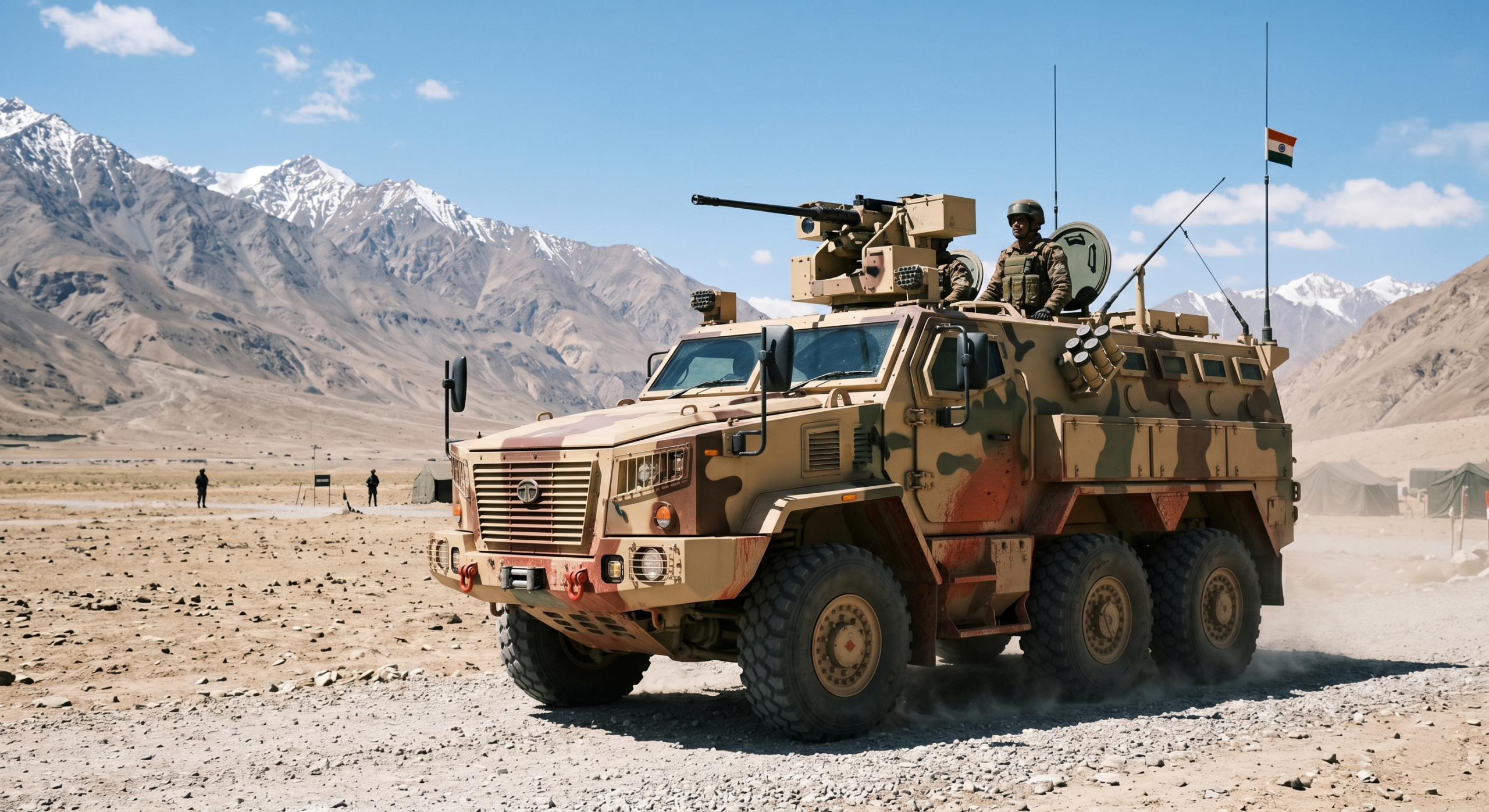
Section 1 ) The Basic Rule – Do You Need a NOC?
If you are exporting anything that qualifies as a military store from India, whether you are a private manufacturer, a PSU, or a trading entity, you need a No Objection Certificate (NOC) from the Department of Defence Production (DDP), Ministry of Defence, before the shipment moves. No exceptions.
Ask yourself three questions first:
1. Does my item appear in the Military Stores list (MS 001 to MS 016)? This covers a wide range: armour, weapons, ammunition, naval vessels, ground vehicles, fire control systems, imaging equipment, ECM electronics, directed energy systems, simulation equipment, and even the software and technology related to any of these. If your product touches any of these categories, you are in scope.
2. Is it “specially designed or modified for military use”? Even if the item looks commercial, this phrase pulls it into the military stores framework. If yes, you need a NOC.
3. Is your item also on the SCOMET list? Some items are dual-listed. If so, you may need both a DGFT export licence and a DDP NOC. Check both lists before proceeding.
If the answer to any of the above is yes, your next step is determining which type of NOC you need.
That depends entirely on why you are exporting: commercial sale, exhibition, testing, or tendering. We cover each scenario in the sections ahead.
Section 2 | Which NOC Track Applies to You?
The DDP SOP splits the NOC process into five tracks based on the purpose of your export. Before you fill out a single form, identify which track you fall under. Everything else, the documents you need, the timeline you are working with, and the approvals required, flows from this.
Part A: You are exporting for commercial sale and your item is in Appendix-II
This is the most regulated track. Appendix-II covers the high-sensitivity items: weapons, ammunition, naval vessels, ground vehicles, fire control systems, imaging equipment, ECM electronics, directed energy systems, and related software and technology. If your item falls here, expect a full inter-agency review process and a government-stamped End User Certificate (EUC) as a hard requirement.
Part B: You are exporting for commercial sale and your item is NOT in Appendix-II
A lighter track. Items like armour, helmets, body protection, production equipment, field generators, and laser protection fall here. The EUC is still required, but there is no inter-agency committee review unless your destination country is on MEA’s negative list.
Part C: You are exporting for an exhibition
No EUC from the importing government is required. But the items must be non-lethal, must not be offered for sale, and must return to India within six months.
Part D: You are exporting for testing and evaluation
Similar to Part C in structure. Items must be non-lethal, not for sale, and returned within one year. You will also need proof of consent from the testing agency.
Part E: You need in-principle approval to participate in a tender or RFP
This track gives you a clearance to bid before you have a confirmed order. Once granted, it has a validity of two years and simplifies the subsequent NOC application for actual export.
Quick reference:
| Track | Purpose | EUC Required | Inter-agency Review |
|---|---|---|---|
| Part A | Commercial sale, Appendix-II items | Yes, government-stamped | Yes |
| Part B | Commercial sale, non-Appendix-II items | Yes | No (unless negative list country) |
| Part C | Exhibition | No | Only if Appendix-II item or negative list country |
| Part D | Testing and evaluation | No | Only if Appendix-II item or negative list country |
| Part E | Tender / RFP participation | No (EUC needed at actual export stage) | Only if Appendix-II item or negative list country |
Section 3 | Part A: The Full Process for High-Sensitivity Items (Appendix-II)
If your item falls under Appendix-II, this is the track you are on. Do not underestimate the process. It involves multiple government agencies, a formal committee review, and strict documentation requirements. Here is exactly what you need to do, in order.
Step 1: Confirm your item is in Appendix-II
Appendix-II covers the following at the system/platform level (accessories and components are generally excluded):
- Weapons and arms (MS 002)
- Bombs, grenades, mines, depth charges (MS 003)
- Ammunition and fuze setting devices (MS 004)
- Vessels of war, surface and underwater (MS 006A)
- Military ground vehicles including tanks and armoured vehicles (MS 007)
- High velocity kinetic energy weapon systems (MS 008)
- Imaging and countermeasure equipment (MS 009)
- Military training simulators (MS 010)
- Electronic countermeasure and surveillance systems (MS 013)
- Directed energy weapon systems (MS 014)
- Software and technology specifically for any of the above
If your item is a component or accessory of any of these, it may fall under Part B instead. Read the Appendix-II list carefully before proceeding.
Step 2: Prepare your application (Appendix-III format)
Your application must be submitted in original using the prescribed Appendix-III format. Key fields to get right:
- Full item description and specifications. Vague descriptions will delay or reject your application.
- Whether the item is specially designed or modified for military use, with supporting details.
- Export order number and date, with a copy attached.
- Complete buyer and end-user details including full addresses.
- Port of shipment, port of discharge, and ultimate destination.
- FOB value per unit and total FOB value.
- Prior export history of the same item to the same or other countries.
Step 3: Obtain your End User Certificate (EUC)
This is non-negotiable for Part A. The EUC must be:
- In the Appendix-IV prescribed format
- Signed and stamped by the government of the end-user country or the ultimate end-user country
- In English. If the original is in another language, a certified English translation from a Notary Public or Indian Embassy abroad is required.
If there are intermediary importers in the chain before the ultimate end user, you need a separate EUC from each intermediary. The chain of transmission must be traceable end to end.
The EUC must contain the following declarations from the end user:
- Items will only be used for the declared purpose.
- Items will not be re-exported without prior authorisation from the Indian government.
- Items will not be diverted, sold, or transferred to any third party.
- Verification of possession will be provided if requested.
- Items will not be used for any weapons of mass destruction related purpose.
Step 4: Understand the inter-agency review
Once your application is received, DDP circulates it to the following agencies for comments within 15 days:
- Ministry of External Affairs (MEA)
- Concerned Service Headquarters
- DRDO
- PIC Wing, Ministry of Defence
- Any other agency deemed necessary
If any agency does not respond within 15 days, their silence is treated as “no objection” and the case moves forward.
A formal committee chaired by the Joint Secretary (Defence Industry Promotion) then examines the application and makes a recommendation. If any stakeholder raises an objection or does not respond, the committee meets after a further 15-day gap. For cases that are particularly sensitive or where the committee cannot reach a final view, the matter escalates to the Defence Exports Steering Committee (DESC), chaired by the Secretary (Defence Production).
Step 5: Cases without a government-stamped EUC
If for any reason you cannot obtain an EUC from the importing country’s government, your case is not automatically rejected. It goes before the same JS(DIP) committee, which examines it on a case-by-case basis. You will need to provide a plausible and documented justification for why the government-stamped EUC could not be obtained. Approval in such cases is discretionary.
Step 6: Receiving and managing your NOC
Once approved:
- The NOC is issued for the entire order or contract in one go.
- Validity is a maximum of two years or completion of the order, whichever comes first.
- Extensions are possible, subject to committee recommendation and competent authority approval.
- The NOC is issued for a specific port of loading. Any change to the port requires a formal endorsement from DDP.
- Customs authorities will endorse the quantity exported on the original NOC at the time of each consignment.
- The NOC will be signed and stamped by two designated DDP officers and copies will be marked to DGFT, Customs, MEA, and the Indian Embassy in the destination country.
Timeline to expect: 4 weeks
Add 2 weeks if the destination country is on MEA’s negative list. Note that exports to Iran are governed by a separate framework entirely under UN Security Council Resolution 2231 (2015) and do not follow this SOP timeline.
Section 4 | Part B: The Lighter Track for Non-Appendix-II Items
If your item is on the Military Stores list but does not appear in Appendix-II, you are on the Part B track. The documentation requirements are simpler, the inter-agency consultation is largely absent, and the timeline is shorter. That said, the NOC is still mandatory and the EUC requirement remains.
What typically falls under Part B
Items that are on the Military Stores list but excluded from Appendix-II include:
- Armoured or protective equipment including helmets, body armour, and ballistic plates (MS 001)
- Fire control and alerting equipment (MS 005)
- Naval propulsion systems and underwater detection components (MS 006B, MS 006C, MS 006D)
- Miscellaneous military equipment including field generators, mobile repair shops, laser protection gear, and military containers (MS 011)
- Production equipment and environmental test facilities for military stores (MS 012)
- Accessories and components of Appendix-II systems (where explicitly excluded from Appendix-II)
Step 1: Prepare your application (Appendix-III format)
The application format is the same as Part A. Use Appendix-III and ensure the following are clearly covered:
- Precise item description and specifications
- Whether the item is specially designed or modified for military use
- Export order number and date with a copy attached
- Full buyer and end-user details
- Port of shipment, discharge port, and ultimate destination
- FOB value per unit and total FOB value
- Prior export history to the same or other countries
Step 2: Obtain your End User Certificate (EUC)
The EUC is still required under Part B, in the Appendix-IV format. The same rules apply:
- Must be in English or accompanied by a certified English translation
- Must carry the declarations covering non-diversion, no re-export without authorisation, no WMD use, and verification on request
- Government stamp from the end-user country is required
The key difference from Part A is that the EUC does not need to be from the government of the importing country in all cases. However, the standard Appendix-IV format and declarations remain mandatory.
Step 3: No inter-agency consultation, with one exception
Unlike Part A, there is no circulation to MEA, Service Headquarters, DRDO, or PIC Wing. The application is processed directly by DDP.
The single exception: if your destination country is on MEA’s negative list, MEA must be consulted and given 15 days to provide comments. Factor this into your planning if you are shipping to a country that may be on that list.
Step 4: Receiving and managing your NOC
The NOC mechanics are identical to Part A:
- Issued for the entire order or contract at one go
- Valid for a maximum of two years or completion of the order, whichever is earlier
- Extensions available subject to competent authority approval
- Port of loading is fixed in the NOC. Any change requires a DDP endorsement.
- Customs endorses quantity shipped on the original NOC at each consignment
- NOC signed and stamped by two designated DDP officers with copies to DGFT, Customs, MEA, and the Indian Embassy in the destination country
Timeline to expect: 2 weeks
Add 2 weeks if the destination is on MEA’s negative list. Still no Iran exception under this track either.
Part A vs Part B at a glance
| Factor | Part A | Part B |
|---|---|---|
| Items covered | Appendix-II (weapons, vessels, vehicles, ECM, DEW, etc.) | All other Military Stores |
| EUC required | Yes, government-stamped | Yes, Appendix-IV format |
| Inter-agency review | Yes, full JS(DIP) committee | No |
| MEA consultation | Always | Only for negative list countries |
| DESC escalation possible | Yes | No |
| Timeline | 4 weeks | 2 weeks |
Section 5 | Part C: Exporting Military Stores for Exhibition Purposes
Defence exhibitions, air shows, and trade expos are an important channel for Indian manufacturers to showcase capabilities and build international relationships. The SOP recognises this and provides a separate, lighter track for temporary exports for exhibition purposes. However, the conditions attached are strict and non-compliance has consequences.
The core difference from Parts A and B
Under Part C, you do not need an End User Certificate from the government of the importing country. The exhibition context is accepted as a known and bounded purpose. What the SOP requires instead is documentation proving your participation and a set of formal undertakings about how the items will be handled.
Step 1: Confirm your item qualifies for Part C
Not every military store can go through the exhibition track. Before applying, confirm all of the following:
- The item is of non-lethal nature. Lethal items cannot be exported under Part C regardless of the exhibition purpose.
- The quantity proposed for export is commensurate with the exhibition purpose. Exporting ten units for a display that requires one will raise questions.
- The item will not be offered for sale at the exhibition.
- The item will be brought back to India within six months of the date of export.
If your item fails any of these conditions, Part C is not available to you.
Step 2: Determine whether your item is an Appendix-II item
This is a critical fork in the road even within Part C.
If your item is an Appendix-II item, the full Part A procedure applies, including consultation with MEA, Service Headquarters, DRDO, and PIC Wing. The exhibition purpose does not waive the inter-agency review for high-sensitivity items.
If your item is not in Appendix-II, the process is lighter. MEA is consulted only if the destination country is on MEA’s negative list.
Step 3: Prepare your application (Appendix-V format)
The Part C application uses a separate format prescribed at Appendix-V. Key fields include:
- Full item description and specifications, including whether specially designed or modified for military use
- Quantity, FOB value per unit, and total FOB value
- Prior export history to the same country or others
- Port of shipment, destination, and port of discharge
- Documentary proof of confirmed participation in the exhibition. This is mandatory. An invitation letter or confirmed exhibitor registration from the organiser is typically required.
Step 4: Submit your undertakings
Your application must include a signed undertaking covering the following:
- The items are of non-lethal nature.
- The items will not be offered for sale.
- The items will be imported back to India within six months of the date of export.
- Proof of re-import, such as a Bill of Entry, will be submitted to DDP within two months of re-import, meaning within eight months from the date the NOC was issued.
This undertaking is a binding commitment. Failure to re-import and submit proof within the stipulated timeframe is a compliance breach.
Step 5: Post-export obligation
This is where many exporters get caught out. The timeline works as follows:
- Export happens
- Items must return to India within 6 months of export
- Bill of Entry or equivalent proof of re-import must be submitted to DDP within 2 months of re-import
- Total outer limit from NOC issuance to proof submission: 8 months
Mark these dates in your compliance calendar from the moment the NOC is issued. Do not wait until the items have returned to start the paperwork.
Timeline to expect
The SOP does not specify a separate processing timeline for Part C. In practice, if the item is non-Appendix-II and the destination is not a negative list country, expect processing closer to the Part B timeline of 2 weeks. If the item is Appendix-II, plan for the Part A timeline of 4 weeks.
Key risk to watch
Exporting military stores under the exhibition track and then selling or leaving the items abroad is a serious violation. The non-sale and re-import undertakings are verified by DDP and the government retains the right to seek verification both before and after export. Treat the re-import deadline as a hard compliance obligation, not an administrative formality.
Section 6 | Part D: Exporting Military Stores for Testing and Evaluation
Indian defence manufacturers increasingly need to send products abroad for independent testing, evaluation trials, and qualification assessments by foreign agencies. The SOP provides a dedicated track for this purpose under Part D. The structure is similar to Part C but with some important differences in timeline and documentation.
The core difference from Part C
Both Part C and Part D are temporary export tracks that do not require a government-stamped EUC. However, Part D has two distinct differences:
- The re-import period is longer: one year instead of six months.
- You need proof of consent from the testing agency, which is not required under Part C.
Additionally, Part D explicitly allows for the possibility that items may be destroyed during testing rather than returned, and provides a compliance pathway for that outcome.
Step 1: Confirm your item qualifies for Part D
Before applying, confirm all of the following:
- The item is of non-lethal nature.
- The quantity proposed is commensurate with the testing and evaluation purpose. Overstating quantity will attract scrutiny.
- The item will not be offered for sale.
- The item will either be returned to India within one year of export or proof of its destruction will be submitted within the same period.
Step 2: Determine whether your item is an Appendix-II item
The same fork in the road applies here as in Part C.
If your item is an Appendix-II item, the full Part A inter-agency consultation procedure applies, covering MEA, Service Headquarters, DRDO, and PIC Wing. The testing purpose does not waive this review for high-sensitivity items.
If your item is not in Appendix-II, MEA is consulted only if the destination country is on MEA’s negative list.
Step 3: Prepare your application (Appendix-VI format)
Part D uses its own prescribed format at Appendix-VI. In addition to the standard fields covering item description, quantity, FOB value, export history, and routing details, this format requires two specific additional items:
- Justification for testing or evaluation: A clear written explanation of why the item needs to be tested abroad, what the test involves, and what outcome is expected. A vague justification is a common reason for delay.
- Proof of consent from the testing agency: A formal letter, agreement, or communication from the overseas testing body confirming they have agreed to conduct the evaluation. This document must be attached to your application.
Step 4: Submit your undertakings
Your application must include a signed undertaking covering the following:
- The items are of non-lethal nature.
- The items will not be offered for sale.
- The items will be imported back to India within one year of the date of export, or proof of destruction will be submitted within one year of export.
- Proof of re-import, such as a Bill of Entry, or proof of destruction will be submitted to DDP within two months of re-import or destruction.
Step 5: Post-export obligation and timeline
The compliance timeline under Part D is the most extended of all the temporary export tracks:
- Export happens
- Items must return to India or be destroyed within 1 year of export
- Proof of re-import or destruction must be submitted to DDP within 2 months of that event
- Total outer limit from date of export to proof submission: 14 months
Track this timeline carefully. The 14-month outer limit is stated explicitly in the SOP and DDP will expect documentation within that window.
Destruction as an outcome
This is a practical provision for items that undergo destructive testing, such as ballistic trials, blast evaluations, or stress-to-failure assessments. If the item will not survive the test, you need to plan for this at the application stage. Your undertaking should reflect the possibility of destruction and your proof of destruction, whether a test report, certificate of destruction, or equivalent document from the testing agency, must be submitted to DDP within the prescribed timeframe.
Part C vs Part D at a glance
| Factor | Part C | Part D |
|---|---|---|
| Purpose | Exhibition | Testing and evaluation |
| EUC required | No | No |
| Additional document | Proof of exhibition participation | Justification plus testing agency consent |
| Re-import period | 6 months | 1 year |
| Destruction permitted | No | Yes, with proof |
| Proof submission deadline | 8 months from NOC | 14 months from export |
| Lethal items permitted | No | No |
Section 7 | Part E: In-Principle Approval for Tender and RFP Participation
Winning a defence export contract often requires participating in a competitive tender or responding to a Request for Proposal (RFP) or Notice Inviting Tender (NIT) long before an actual order is confirmed. Sending sample items or demonstrating capabilities during this process requires export authorisation, but obtaining a full NOC without a confirmed contract is impractical. Part E addresses this gap by providing an in-principle approval track that lets you participate in the bidding process without waiting for a firm order.
What Part E actually gives you
Part E does not give you a final NOC for commercial export. It gives you a pre-clearance to:
- Export samples for tender participation
- Demonstrate products in response to an RFP or NIT
- Explore export opportunities in a target market
Once you win the tender or confirm the order, you will still need to apply for a full NOC for actual export. However, if the MEA consultation was completed at the in-principle stage, it does not need to be repeated at the NOC stage, which significantly shortens the subsequent process.
Step 1: Confirm your item qualifies for Part E
Before applying, confirm all of the following:
- The item is of non-lethal nature.
- The quantity proposed is commensurate with the tender or demonstration purpose.
- The item will not be offered for sale.
- The item will be returned to India within six months of export, or if return is not feasible, an undertaking will be obtained from the end user confirming the item will not be diverted, sold, or transferred to any third party.
Step 2: Determine whether your item is an Appendix-II item
The same classification fork applies here.
If your item is an Appendix-II item, the full Part A inter-agency consultation procedure applies, including MEA, Service Headquarters, DRDO, and PIC Wing. Tender participation does not waive this for high-sensitivity items.
If your item is not in Appendix-II, MEA is consulted only if the destination country is on MEA’s negative list.
Step 3: Prepare your application (Appendix-VII format)
Part E uses its own prescribed format at Appendix-VII. In addition to the standard fields covering item description, quantity, FOB value, and routing details, this format requires:
- A clear statement of the requirement for export, specifically referencing the RFP, NIT, or tender you are responding to.
- Valid supporting documents such as the RFP document, NIT notice, or official tender invitation confirming the requirement.
Step 4: Submit your undertakings
Your application must include a signed undertaking covering the following:
- The items are of non-lethal nature.
- The items will not be offered for sale.
- The items will be imported back to India within six months of export. Where return is not feasible, an undertaking from the end user will be obtained confirming no diversion, sale, or transfer to any third party.
- Proof of re-import, such as a Bill of Entry, will be provided to DDP within two months of re-import.
Step 5: Validity of in-principle approval
The in-principle approval under Part E is valid for:
- Two years from the date of issue, or
- The period covered under your application, whichever is less.
This gives you a meaningful window to pursue the tender, negotiate, and progress toward contract award without needing to reapply for each stage of the bidding process.
Step 6: The subsequent NOC for actual export
When the tender is won and actual export is ready to proceed, you must submit a fresh application for the full NOC using the Appendix-VII format along with an EUC in Appendix-IV format, in original.
The key benefit of having completed Part E properly is that if MEA consultation was done at the in-principle stage, it does not need to be repeated. This can save two to four weeks depending on the destination country.
However, there is an important caveat: if foreign policy or national security considerations have changed in the intervening period, DDP retains the right to review and potentially revoke the in-principle approval. If this happens, DDP will inform the applicant directly.
Step 7: Post-export obligation
- Items must return to India within 6 months of export
- Proof of re-import must be submitted to DDP within 2 months of re-import
- Total outer limit: 8 months from NOC issuance
- Where return is not feasible, the end-user undertaking on non-diversion substitutes for the re-import proof obligation
Part E vs Parts C and D at a glance
| Factor | Part C | Part D | Part E |
|---|---|---|---|
| Purpose | Exhibition | Testing and evaluation | Tender / RFP participation |
| EUC at application stage | No | No | No |
| EUC at actual export stage | Not applicable | Not applicable | Yes, required |
| Additional document | Exhibition proof | Testing consent plus justification | RFP / NIT / tender documents |
| Re-import period | 6 months | 1 year | 6 months |
| Destruction permitted | No | Yes | No |
| Approval validity | Per NOC | Per NOC | 2 years or application period |
| MEA re-consultation at export stage | Not applicable | Not applicable | Not required if done at in-principle stage |
Section 8 | Timelines, the MEA Negative List, and the Iran Carve-Out
Understanding the processing timelines under this SOP is not just useful for planning. It is essential for managing customer commitments, export order deadlines, and internal compliance calendars. This section consolidates the timeline framework, explains the MEA negative list trigger, and addresses the Iran carve-out which operates entirely outside the standard SOP.
Standard Processing Timelines
The SOP prescribes the following base timelines for NOC issuance:
| Track | Base Timeline | Additional Time for Negative List Countries |
|---|---|---|
| Part A (Appendix-II items) | 4 weeks | Plus 2 weeks |
| Part B (Non-Appendix-II items) | 2 weeks | Plus 2 weeks |
| Parts C, D, E | Not specified, apply Part A or B timeline based on item classification | Plus 2 weeks if applicable |
These are processing timelines from the point of receiving a complete application. An incomplete application, missing EUC, absent translation, or vague item description will reset the clock. Submit a complete and precise application from the outset.
The 15-Day Consultation Window
Within the inter-agency consultation process under Part A, each agency consulted including MEA, Service Headquarters, DRDO, and PIC Wing has 15 days to respond. Silence after 15 days is treated as no objection and the case moves forward. If objections are raised, the JS(DIP) committee convenes after a further 15-day gap. These windows are built into the 4-week base timeline but can compound if multiple rounds of review are needed or if the matter escalates to DESC.
The MEA Negative List
The MEA negative list is a list of countries to which India exercises heightened caution in foreign policy and defence export matters. The SOP does not publish this list within its text. It is maintained by MEA and updated periodically based on foreign policy considerations.
The practical implications for exporters are as follows:
- Under Part A, MEA consultation is always mandatory regardless of destination. The negative list does not add a separate step here but may affect the outcome of that consultation.
- Under Parts B, C, D, and E, MEA consultation is only triggered if the destination country is on the negative list. If triggered, MEA is given 15 days to respond, adding up to 2 weeks to your processing timeline.
- In all cases of export to a negative list country, MEA consultation is mandatory regardless of which part of the SOP applies.
If you are unsure whether your destination country is on MEA’s negative list, treat it as if it is and plan for the additional 2-week window. Do not assume and do not guess.
Endorsements on the NOC
Once your NOC is issued, two ongoing compliance obligations attach to it for the life of the export contract:
- Customs endorsement: At the time of each consignment, Customs authorities will endorse the quantity being exported on the original NOC. Keep the original NOC accessible and present it at each shipment.
- Port of loading: The NOC is issued for a specific port of loading stated in your application. If the port changes at any point during the contract, you must obtain a formal endorsement from DDP before shipping. Shipping from an unendorsed port is a compliance breach.
NOC Validity and Extensions
Every NOC issued under Parts A and B is valid for the lesser of:
- Two years from the date of issue, or
- Completion of the order or contract
If your contract runs beyond two years or circumstances delay execution, you can apply for an extension. Extensions are granted based on merit and require:
- Under Part A: recommendation of the JS(DIP) committee and competent authority approval
- Under Part B: competent authority approval
Do not allow your NOC to lapse without either completing the shipments or obtaining an extension. Shipping against an expired NOC is a violation.
The Iran Carve-Out
Iran sits entirely outside the standard SOP framework. The SOP states explicitly that the standard processing timelines do not apply to Iran and that exports of military stores to Iran are governed by Annexure B to UN Security Council Resolution 2231 (2015), adopted at the 7488th meeting of the Security Council on 20 July 2015.
Resolution 2231 endorsed the Joint Comprehensive Plan of Action (JCPOA) and established a specific framework governing the transfer of arms, military equipment, and related items to and from Iran. The practical implications for Indian exporters are:
- Do not apply the standard NOC SOP process to any military stores export involving Iran as a destination, transit point, or end-user country.
- Seek specific legal and regulatory advice before engaging with any Iran-connected military stores transaction.
- The UN framework under Resolution 2231 imposes its own approval requirements, timelines, and restrictions that operate independently of and above the DDP SOP.
Consolidated Timeline Reference
| Scenario | Expected Timeline |
|---|---|
| Part A, non-negative list country | 4 weeks |
| Part A, negative list country | 6 weeks |
| Part B, non-negative list country | 2 weeks |
| Part B, negative list country | 4 weeks |
| Parts C, D, E with non-Appendix-II item, non-negative list country | Approximately 2 weeks |
| Parts C, D, E with Appendix-II item | Approximately 4 to 6 weeks depending on destination |
| Any export to Iran | Outside standard SOP, separate UN framework applies |
One Final Compliance Note
The SOP contains a standing reservation clause: the issue of this SOP does not prevent DDP from imposing additional conditions in specific cases if considered necessary. This means even a fully compliant application can attract bespoke conditions at DDP’s discretion. Build flexibility into your export planning and treat the SOP as a floor, not a ceiling, for compliance requirements.
Leave a Reply