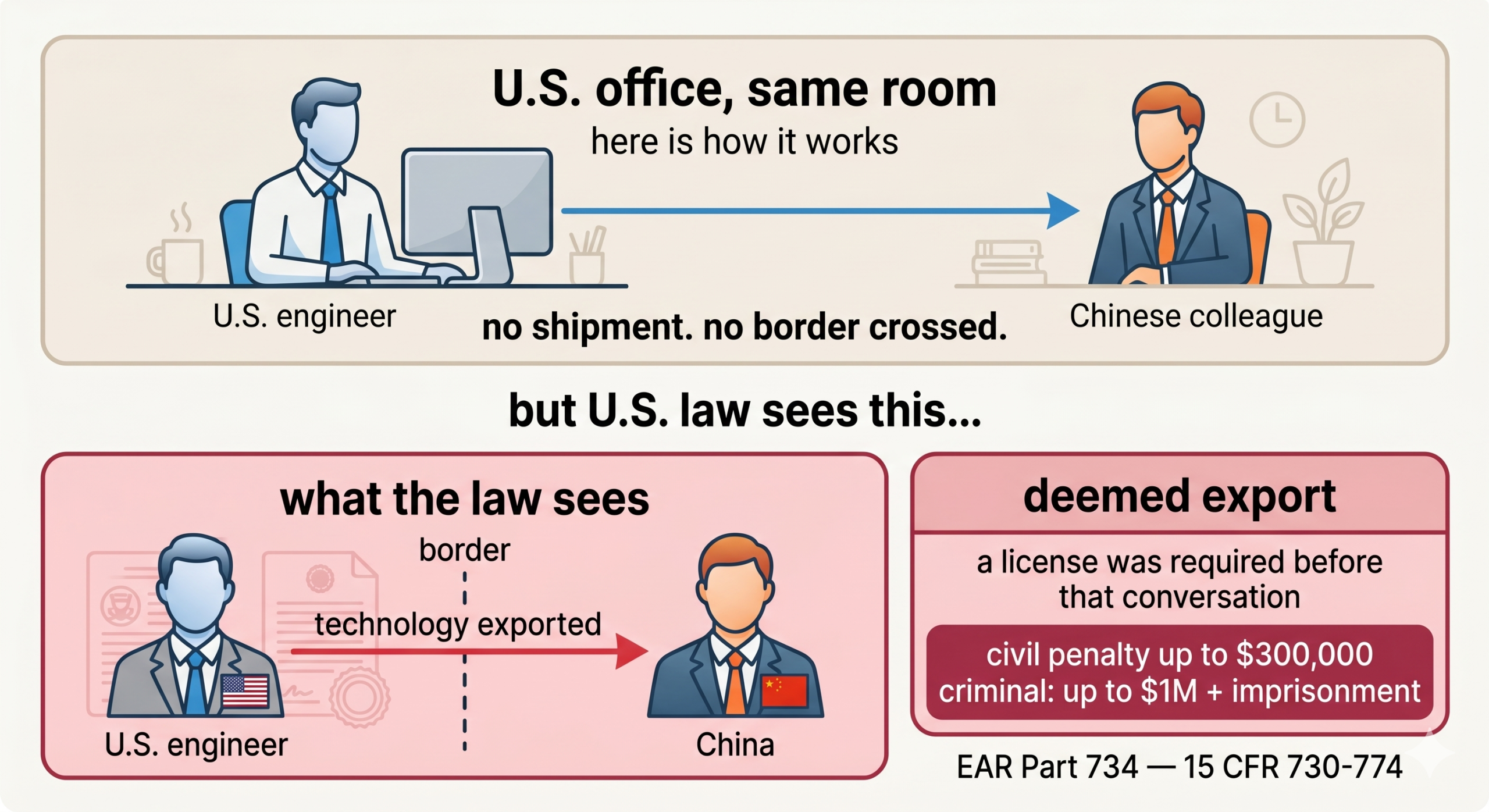
A deemed export is when sharing knowledge with a foreigner inside the U.S. counts legally as exporting that knowledge to their country.
Normally an export means physically sending something out of the U.S. to another country.
A deemed export is different. It happens inside the U.S.
The moment you share controlled technology or technical knowledge with a foreign person standing right next to you in the U.S., the law treats that conversation or transfer as if you just exported that information to their home country.
A Simple Example
You are a U.S. engineer. Your company has a foreign colleague from China working in the same office. You explain to them how a sensitive piece of technology works.
You did not ship anything. You did not cross any border. But in the eyes of U.S. law, you just exported that knowledge to China. That is a deemed export. And if that technology required an export license, you needed one before that conversation happened.
Who Needs to Worry About This
Universities, research labs, biotech firms, medical and computer companies. Basically anyone where foreign nationals work alongside sensitive technology or research.
Who is Exempt
Permanent residents (green card holders), U.S. citizens, and certain protected individuals are excluded from this rule.
Also exempt: fundamental research that gets published openly and shared across the scientific community, and anything based on publicly available information.
The regulation governing deemed exports is:
Export Administration Regulations (EAR), 15 CFR Parts 730-774, administered by the Bureau of Industry and Security (BIS), U.S. Department of Commerce.
734.13(a)(2) –> definition of deemed export
734.13(b) –> country of nationality rule
734.8 –> fundamental research exemption
734.15 –> definition of a “release” of technology or source code
734.20 –> activities that are not deemed reexports
Leave a Reply