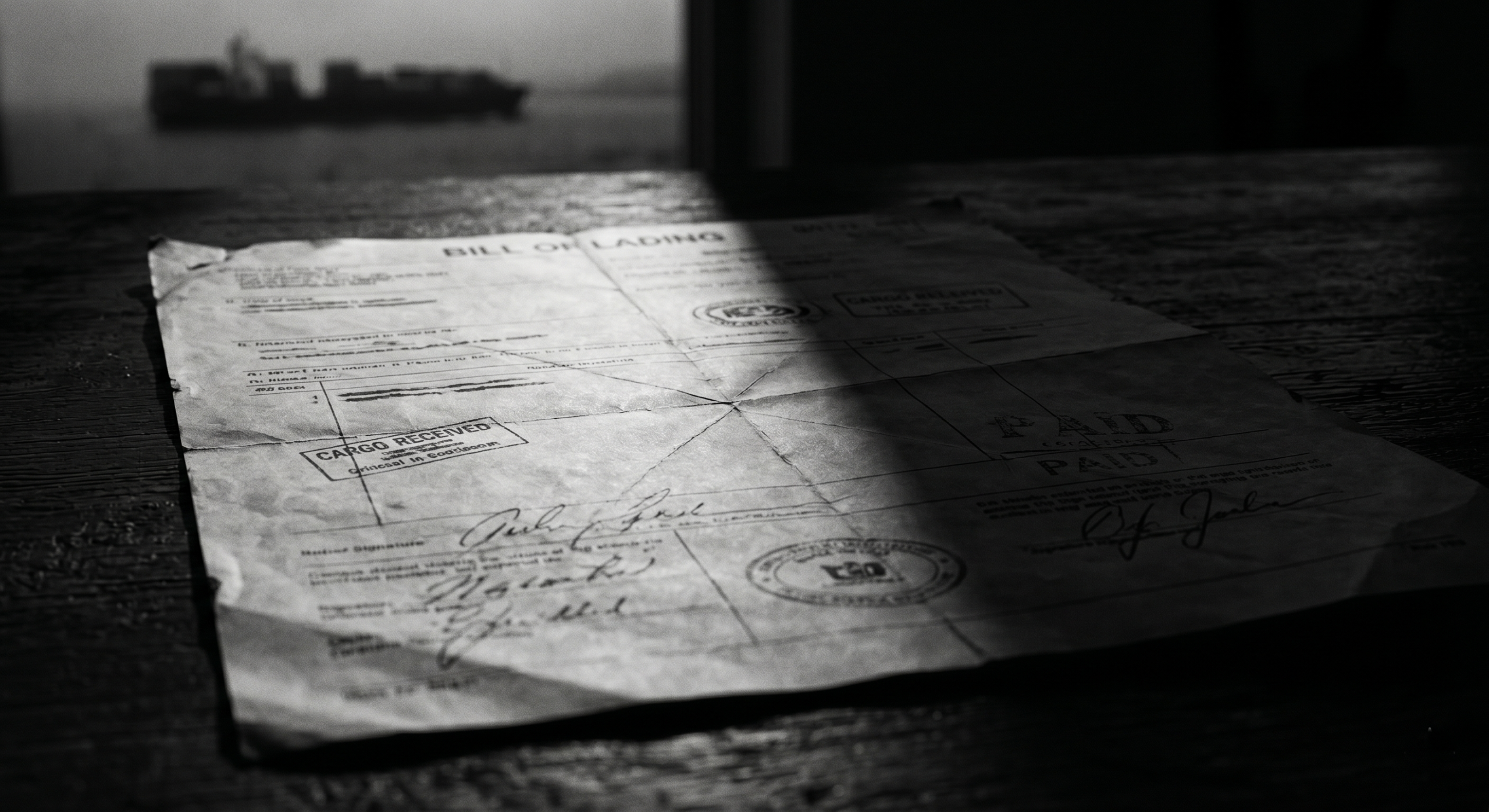
The Bill of Lading is Still a Piece of Paper in 2026. That Should Terrify You.
Every major industry has digitised its most critical documents. Banking moved to electronic transfers decades ago. Aviation ticketing went paperless in 2008. Land registry in most countries is now fully digital. Yet international shipping, an industry that moves over 80 percent of world trade by volume, still relies on a physical piece of paper to transfer ownership of cargo worth billions of dollars every single day. And the fraud that flows from that reality is not theoretical. It is happening right now, in ports you ship through, on vessels your cargo is travelling on.
This is not a technology gap story. It is a legal, commercial, and operational risk story that most shippers, traders, and even experienced freight professionals do not fully understand until the day their cargo disappears.
What the Bill of Lading Actually Is and Why the Paper Matters
Most people in shipping treat the Bill of Lading as a receipt. It is not just a receipt. Under English law and the laws of most maritime jurisdictions, an original negotiable Bill of Lading is a document of title. Whoever physically holds the original is, in the eyes of the law and in the eyes of the carrier, entitled to the cargo.
This is not a technicality. This is the entire foundation of international commodity trade, trade finance, and letters of credit. The BL is the instrument through which ownership of goods moves from seller to buyer while the ship is still at sea. A bank finances a shipment and holds the BL as security. A commodity trader sells a cargo five times while it is on the water. In each case, the transfer of the original paper document is the transfer of the goods themselves.
When three original Bills of Lading are issued, as is standard practice, the carrier is obligated to release the cargo to whoever presents any one of the three originals first. The other two become worthless the moment the first one is surrendered. This system was designed in an era of sailing ships and courier pigeons. It is still the operative legal framework in 2026.
The Fraud Scenarios That Are Actually Happening
Scenario One: The Cargo Arrives Before the Paper
This is the most common and most underappreciated problem in modern container shipping. A shipment from Shanghai to Nhava Sheva on a fast direct service takes 18 to 22 days. The physical BL, sent by courier from the exporter in China to the bank in India to the importer, can take the same amount of time or longer if there are any delays in the banking chain or document preparation.
The cargo arrives. The importer needs it urgently. The original BL has not arrived yet. So the carrier is approached to release the cargo against a Letter of Indemnity, an LOI, signed by the importer and sometimes countersigned by their bank, promising to produce the original BL later and to indemnify the carrier against any loss.
Carriers release cargo this way thousands of times a day globally. It is standard practice. It is also legally a release of cargo without title. If a second party simultaneously presents the original BL, the carrier has a serious problem. And if the importer who took the cargo against the LOI subsequently goes bankrupt or disappears, the seller or the financing bank holding the original BL is left with a piece of paper that no longer controls anything.
Scenario Two: The Forged Original
In the Motis Enterprises v Dairy Containers case, cargo was released by the carrier against a forged Bill of Lading. The carrier had no way to verify the document’s authenticity because there is no central registry, no digital verification system, and no watermark technology that cannot be replicated by a reasonably sophisticated fraudster. The court held the carrier liable. But getting money back from a carrier through litigation takes years and rarely recovers full value.
The practical reality is this: a criminal with access to a genuine BL template, a colour printer, and basic knowledge of shipping documentation can produce a document that most port agents and terminal operators will accept without question. There is no QR code to scan. There is no blockchain ledger to check against. There is no phone number to call to verify authenticity in real time. There is a piece of paper and a signature.
Scenario Three: The Switch Bill of Lading
A Switch BL is a second set of original Bills of Lading issued to replace the first set, usually to conceal the origin of goods, the identity of the original shipper, or the true loading port. This is a legitimate practice in certain trading structures. Commodity traders use it routinely to protect their supplier relationships from being discovered by their buyers.
But the same mechanism is used for sanctions evasion, country of origin fraud, and documentary fraud in trade finance. A shipment loads in a sanctioned jurisdiction. The first set of BLs shows the true origin. The ship calls at an intermediate port. A Switch BL is issued showing the intermediate port as the origin. The cargo enters the destination country with clean documentation.
Customs authorities in most countries have no reliable mechanism to detect this unless they are specifically looking for it. The BL on its face is genuine. The carrier who issued it may not have known the original loading port was sanctioned. The freight forwarder who arranged the Switch may have been acting on instructions. Everyone has deniability. The cargo moves.
Scenario Four: The Sold Three Times Problem
In commodity trading, particularly in oil, grain, and metals, a cargo is routinely sold multiple times while at sea. Each sale is documented by an endorsement on the back of the original negotiable BL, passing title from one party to the next in a chain. This is called an endorsement chain or a string sale.
The fraud happens when a dishonest trader in the chain makes a copy of the original BL before endorsing it and simultaneously presents it to a different buyer or a different bank as if it were the original. Two parties believe they own the same cargo. Only the one who presents their document to the carrier first actually gets the goods. The other has a civil claim against the fraudster, assuming the fraudster can be found and has assets worth pursuing.
Why the Carrier Is Not Your Safety Net
Carriers limit their liability under the Hague-Visby Rules to 2 Special Drawing Rights per kilogram or 666.67 SDR per package, whichever is higher. For a container of electronics, pharmaceuticals, or high-value machinery, this limit covers a fraction of the actual cargo value.
More importantly, if a carrier releases cargo against a forged BL in good faith, their liability position under English law and most maritime jurisdictions is complex and contested. Litigation is expensive, slow, and uncertain. The English Commercial Court is excellent but it is not fast, and it is not cheap.
In practice, once cargo is released and gone, recovery is extremely difficult. The practical protection is not the carrier’s liability. It is prevention.
What Practically Can Be Done
Cargo insurance with specific coverage for documentary fraud is the first line of defence. Most standard marine cargo policies do not cover losses arising from the release of goods against fraudulent documents unless specifically endorsed. Check your policy wording. If it does not explicitly cover fraud and misdelivery, get it amended.
For high value shipments, surrender of original BLs should happen through a bank under a Letter of Credit, not directly between trading counterparties. The LC mechanism, for all its cost and complexity, exists precisely to protect both parties in a transaction where the document controls the goods.
For shipments where LOI release is unavoidable, the LOI must be countersigned by a first-class bank, not just by the importer. A corporate LOI without bank backing is essentially worthless paper in the event of a dispute.
Know your counterparty. Switch BL requests should be treated as a compliance red flag until you understand exactly why the switch is being requested and what it is intended to conceal. In a post-2022 sanctions environment, a Switch BL request on a shipment touching a high-risk jurisdiction is not just a commercial question. It is a compliance question with potential criminal exposure.
The Electronic BL Question
Electronic Bills of Lading exist. BOLERO, essDOCS, and the more recent wave of platforms including the work being done under the UNCITRAL Model Law on Electronic Transferable Records have made genuine progress. The UK passed the Electronic Trade Documents Act in 2023, which for the first time gave electronic trade documents the same legal status as paper under English law.
But adoption remains limited. The reason is not technology. The reason is that the entire ecosystem around the BL, banks, carriers, port authorities, customs administrations, and trading companies, needs to be on the same platform or operating under compatible legal frameworks for electronic BLs to work end to end. A seller in Vietnam, a bank in Dubai, a carrier registered in Greece, a buyer in Brazil, and a customs authority in Morocco all need to recognise and accept the same electronic document. That alignment does not yet exist at scale.
Until it does, the piece of paper travels with the goods. And the fraud travels with the paper.
The Bottom Line
The Bill of Lading is the most important and the most vulnerable document in international trade. Its power derives entirely from physical possession, which means its weakness derives from exactly the same thing. It can be forged. It can be lost. It can arrive after the cargo. It can be used twice. It can be switched to hide what it originally said.
Experienced shipping professionals know the mechanics of the BL. Far fewer of them have genuinely interrogated what happens when the system fails. The scenarios above are not hypothetical. They are the subject of commercial court judgments, insurance claims, and enforcement actions that are processed quietly and without publicity every year across the major trading hubs of London, Singapore, Dubai, and Hong Kong.
The document is as old as maritime trade itself. The fraud is just as old. And in 2026, remarkably little has changed.
Leave a Reply